
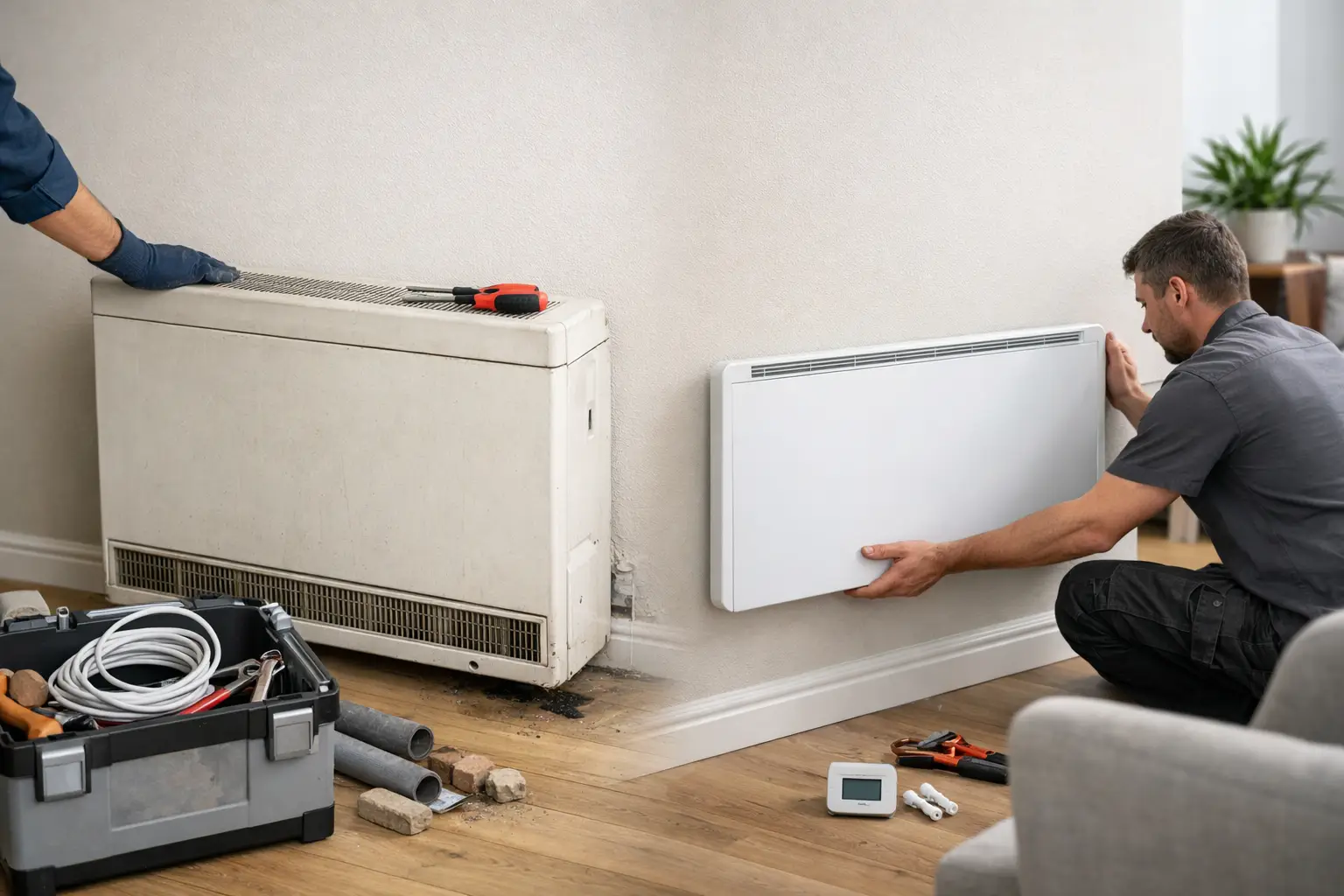
If your storage heaters leave bedrooms cold by morning, make rooms too warm in the evening, or seem to swallow electricity without giving you much control, replacement can make a real difference. This guide to replacing storage heaters helps you compare the realistic options, understand what affects cost and avoid paying for a system that does not suit your home.
Old storage heaters were designed to charge overnight on cheaper electricity, then release that warmth gradually during the day. The idea still has merit, especially in homes without mains gas. The problem is that older models can be difficult to control. They may release heat when you are out, then run out just when you need it.
Replacing them is not simply a case of choosing the newest heater on the shelf. Your insulation, electricity tariff, hot water setup and future plans all matter.
Start with why your current heaters are not working
Before choosing a replacement, pinpoint the issue. If the heaters are old, poorly controlled or damaged, modern high-heat-retention storage heaters may solve the problem without major changes to your home. If every room feels cold and draughty, though, spending money on new heating before tackling insulation could lead to disappointing results.
Look at how you use the property too. A household that is occupied during the day may benefit from stored heat being released steadily. If everyone is out at work or school, you may need more responsive heating for the morning and evening instead.
It is also worth checking your electricity tariff. Traditional storage heaters were usually paired with Economy 7 or another time-of-use tariff. The cheaper overnight period varies by supplier and area, so do not assume the hours on an old meter still match the deal you are paying for. A tariff that no longer suits your routine can make even a decent heating system feel expensive.
Your main options for replacing storage heaters
There is no single best answer for every home. The right choice depends on the property, budget and how much work you are prepared to have done.
Modern storage heaters
For many all-electric homes, modern storage heaters are the most straightforward replacement. High-heat-retention models hold warmth more effectively and use built-in controls to decide when to charge and release heat. You can generally set programmes for different rooms and days, giving you much more control than an older input and output dial.
They are usually less disruptive to install because they can often use the existing electrical supply, although this still needs checking. They can be a sensible choice where the home has suitable off-peak electricity and the owner wants a manageable upgrade rather than a whole new heating system.
The trade-off is that storage heating still relies on electricity being stored in advance. It is more flexible than older systems, but it will not feel exactly like turning on a gas-fired radiator whenever you want instant heat.
Air source heat pumps
An air source heat pump takes warmth from outside air and uses it to heat your home and hot water. It runs on electricity but can produce several units of heat for each unit of electricity used, which is why it can offer lower running costs than direct electric heating in a suitable, well-prepared home.
A heat pump is a bigger change. It normally needs radiators or underfloor heating, a hot water cylinder and space outside for the unit. Some homes previously heated by storage heaters will need pipework installed, which adds time and cost. It also works best when heat loss is under control, so insulation and draught-proofing are often part of the conversation.
For the right property, this can be a long-term route to more consistent warmth and lower bills. For a poorly insulated home or a household needing the lowest upfront cost, it may not be the first step. Funding may be available for eligible households through schemes such as ECO4, but support depends on your home, circumstances and local availability.
Electric panel heaters and infrared heating
Electric panel heaters are slim, quick to fit and easy to control room by room. They can work well in a rarely used spare room, an extension or as supplementary heating. They are not automatically a cheaper whole-home replacement for storage heaters, however, because they create heat directly from electricity at the rate you pay at the time.
Infrared panels are sometimes promoted as a simple alternative. They heat surfaces and people in their path rather than warming the room air in the same way as a conventional heater. Some households like the feeling in small spaces, but they are not a guaranteed low-cost answer for heating an entire house. Ask for estimated running costs based on your actual room sizes, insulation and tariff, not broad claims.
A boiler and wet central heating
Where mains gas is available, some homeowners consider replacing storage heaters with a modern gas boiler and radiators. This can provide familiar, responsive heating, but installation can be disruptive if the home has no existing pipework. Running costs also depend on energy prices, and a gas system is not a renewable heating solution.
In some cases, a modern electric boiler may be considered, particularly where gas is unavailable. It still uses direct electricity, so it needs careful running-cost calculations. A boiler is not automatically the cheapest option simply because it gives you radiators.
What to check before you replace storage heaters
A proper home assessment should come before a quote. The installer needs to understand more than the number of heaters on your walls. Room dimensions, window condition, insulation, draughts, electrical capacity and your daily routine all affect the system size and design.
Pay particular attention to these four areas:
- Heat loss: Loft insulation, wall insulation, glazing and draughts determine how quickly your home loses warmth. Improving them can allow smaller, cheaper heating equipment to do the job properly.
- Your electrics: Older consumer units, circuits and wiring may need upgrading. Storage heaters and heat pumps should be installed and connected by suitably qualified professionals.
- Hot water: Storage heaters only heat rooms. If you have an immersion heater and cylinder for hot water, check whether this is also costly or unreliable. Replacing room heating may be the right time to plan hot water improvements.
- Your future plans: Solar panels and battery storage can help you make more use of electricity generated at home, but they do not remove the need for a correctly sized heating system. They work best as part of an overall plan.
If your storage heaters are very old, do not remove or dismantle them yourself. Some older units may contain materials that need specialist handling. A professional can assess safe removal and disposal before work starts.
How much does it cost to replace storage heaters?
Costs vary widely because the work can range from swapping a few heaters to installing a full heat pump system with new radiators and a cylinder. The number of rooms, condition of the wiring, access to the property and insulation upgrades all affect the final figure.
The cheapest quote is not always the lowest-cost decision over time. An undersized heater can leave a room cold, while an oversized system can cost more to buy and run than necessary. Ask for a clear written breakdown showing equipment, electrical work, removal of old heaters, controls, any making-good work and VAT. That makes it far easier to compare like for like and spot hidden costs.
It is also sensible to ask for expected running costs, but treat these as estimates rather than promises. They should be based on your tariff, the proposed system and reasonable assumptions about how you live in the property.
A simple replacement plan
Start by gathering a year of electricity bills and noting which rooms are uncomfortable. Then arrange a home assessment rather than relying on a remote price alone. A good assessment should explain your choices in plain English, including where a lower-cost upgrade may be enough and where a larger change could bring better long-term value.
Once you have chosen a route, confirm the installation schedule, whether old units will be removed, and what disruption to expect. If you are moving to a heat pump or wet heating system, ask how the system will be commissioned and how you will be shown to use the controls. Good controls matter as much as good equipment.
For homeowners across Scotland and England, Newtech Renewables can help make sense of practical heating upgrades, from initial suitability checks through to installation. The aim should be a warmer home and bills you can better manage, without being pushed into technology that is more complicated or expensive than your property needs.
The best replacement is the one that fits how your home loses heat and how your household lives in it. Start with an honest assessment, ask clear questions about costs and controls, and you will be in a far stronger position to choose heating that feels comfortable every day.