A boiler often gives you a warning before it stops working completely. The heating takes longer to come on, the hot water changes temperature halfway through a shower, or the pressure keeps dropping for no obvious reason. Knowing the top signs your boiler needs replacing can help you avoid an expensive breakdown, a cold home and a rushed decision when you need heating most.
A repair can be the sensible, lower-cost choice in many cases. But if problems keep returning, your bills are rising or parts are becoming difficult to source, putting money into an ageing boiler may not offer good value. Here is what to look out for and how to decide what makes sense for your home.
Top signs your boiler needs replacing
1. Your boiler is more than 10 to 15 years old
Age alone does not mean a boiler must be replaced. Some well-maintained boilers keep running reliably beyond 15 years. However, older models are generally less efficient than a modern A-rated boiler, and wear on internal components becomes more likely over time.
If your boiler is approaching this age range and has started needing repairs, it is worth comparing the repair cost with the benefit of a replacement. A newer boiler can use less fuel to produce the same warmth, which may help bring down your heating bills while improving comfort around the house.
2. Repairs are becoming a regular expense
One repair after a number of trouble-free years is not necessarily a reason to replace your boiler. A faulty valve, pump or thermostat can often be fixed at a reasonable cost.
The picture changes when you are calling out an engineer every few months, paying for several different parts, or fixing the same fault repeatedly. Those costs soon add up, and the next issue may be just around the corner. If a major repair represents a large proportion of the cost of a new boiler, replacement is usually worth considering.
3. Your energy bills are rising without a clear reason
Energy prices change, and so does how much heating a household uses, especially during a cold Scottish or English winter. Still, a noticeable increase in gas use can be a sign that your boiler is no longer working as efficiently as it should.
As boilers age, they can lose efficiency through worn components, poor combustion or a system that is struggling with sludge and debris. Before deciding on a replacement, have the boiler and controls checked. Sometimes a service, system clean or improved heating controls can make a real difference. If the boiler remains inefficient after that, an upgrade may provide better long-term value.
4. Your home has cold rooms or uneven heating
Radiators that stay lukewarm, rooms that take hours to warm up and heating that feels unreliable can all point to a boiler or central-heating-system issue. It may be a straightforward problem such as trapped air, a faulty thermostatic radiator valve or a system that needs balancing.
But when these issues sit alongside an old boiler, frequent faults or poor hot water performance, they can indicate that the system is no longer coping well. A proper assessment matters here. Replacing a boiler without looking at radiator sizing, pipework, controls and insulation can leave you disappointed with the result.
5. The boiler makes unusual noises
Boilers are not silent, but banging, whistling, gurgling or a sound similar to a kettle boiling should not be ignored. This is often called kettling and can happen when limescale or sludge restricts the flow of water through the heat exchanger.
A heating engineer may be able to resolve the cause with a repair or powerflush, depending on the system. Yet if the noise returns, the boiler overheats or the heat exchanger is damaged, a replacement may be the more dependable option. Leaving it too long can lead to a bigger failure and a more costly fix.
6. The pressure keeps dropping
Most modern boilers show their pressure on a gauge or digital display. If you have to top it up regularly, there may be a leak in the system, an issue with the expansion vessel or a fault within the boiler itself.
Topping up the pressure occasionally is normal in some circumstances, but doing it frequently is not a solution. It is best to arrange an inspection rather than keep adding water. Repeated pressure loss can affect heating performance and may point to a repair that is no longer worthwhile on an older boiler.
7. Hot water is unreliable
A combi boiler should give you hot water when you need it. If the water runs hot and cold, takes a long time to heat up, has weak flow, or only works when the heating is on, there may be a fault with the boiler or your wider plumbing system.
In some homes, the problem is simply that the boiler is not the right size for current demand. A household with an extra bathroom, more people living in it or a new extension may have outgrown its original system. A replacement gives you the opportunity to choose a boiler that suits how your home is used now, rather than how it was used years ago.
8. Parts are obsolete or difficult to find
Manufacturers eventually stop making parts for older boiler models. Once that happens, an engineer may have limited options, and even a small fault can turn into a lengthy and expensive search for a suitable part.
If you have been told that a key component is obsolete, replacement is often the practical route. It avoids spending money on a temporary fix for a boiler that may be difficult to maintain in future.
When a boiler problem is an emergency
Some warning signs need immediate action, not a decision about replacement. If you smell gas, think you have a gas leak, or your carbon monoxide alarm sounds, turn off the gas supply if it is safe to do so, leave the property and call the National Gas Emergency Service on 0800 111 999.
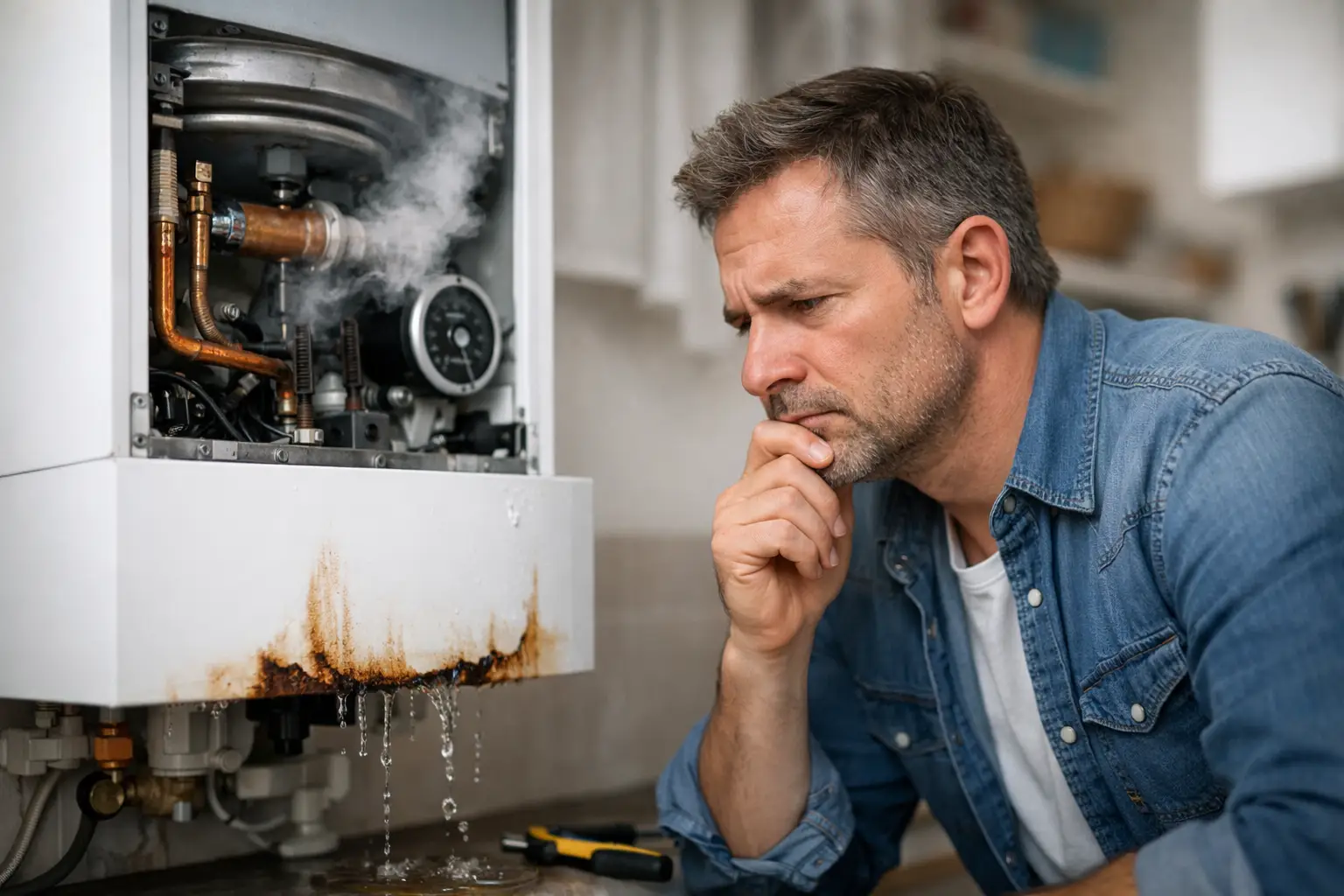
You should also act quickly if you notice soot or dark staining around the boiler, a yellow or lazy flame rather than a crisp blue flame, or symptoms such as headaches, dizziness and nausea that improve when you leave the house. Do not attempt to repair a gas boiler yourself. Always use a Gas Safe registered engineer.
Repair or replace: a simple way to decide
Start with the age of the boiler, the nature of the fault and the total cost of keeping it running. A newer boiler with a one-off issue is often worth repairing. An older boiler with recurring breakdowns, poor efficiency and hard-to-find parts is usually a stronger case for replacement.
It also helps to look beyond the boiler itself. Modern controls, a smart thermostat, thermostatic radiator valves and a properly balanced system can help you get more from your heating. For some properties, especially those planning wider energy improvements, it may also be worth discussing whether an air source heat pump could suit the home better. That depends on insulation, heat loss, radiator capacity, available space and budget, so there is no one-size-fits-all answer.
What to expect from a boiler replacement
A good installer should assess your home before recommending a boiler. They should ask about the number of bathrooms, your hot water use, the size of the property, existing radiators and any comfort problems you want to solve. The cheapest boiler is not always the best value if it is undersized, unsuitable or leaves you with poor controls.
Ask for clear information on the boiler model, warranty, controls, any pipework or radiator work required, timescales and the full price. This makes it easier to compare quotes fairly and avoid unexpected extras. If you may be eligible for funded heating or energy-efficiency improvements, it is worth checking this before committing to a private installation.
A replacement boiler should bring peace of mind, not more confusion. If your current system is showing several of these signs, a friendly home assessment can give you a clear view of your options, expected costs and the most practical route to a warmer, more efficient home.