
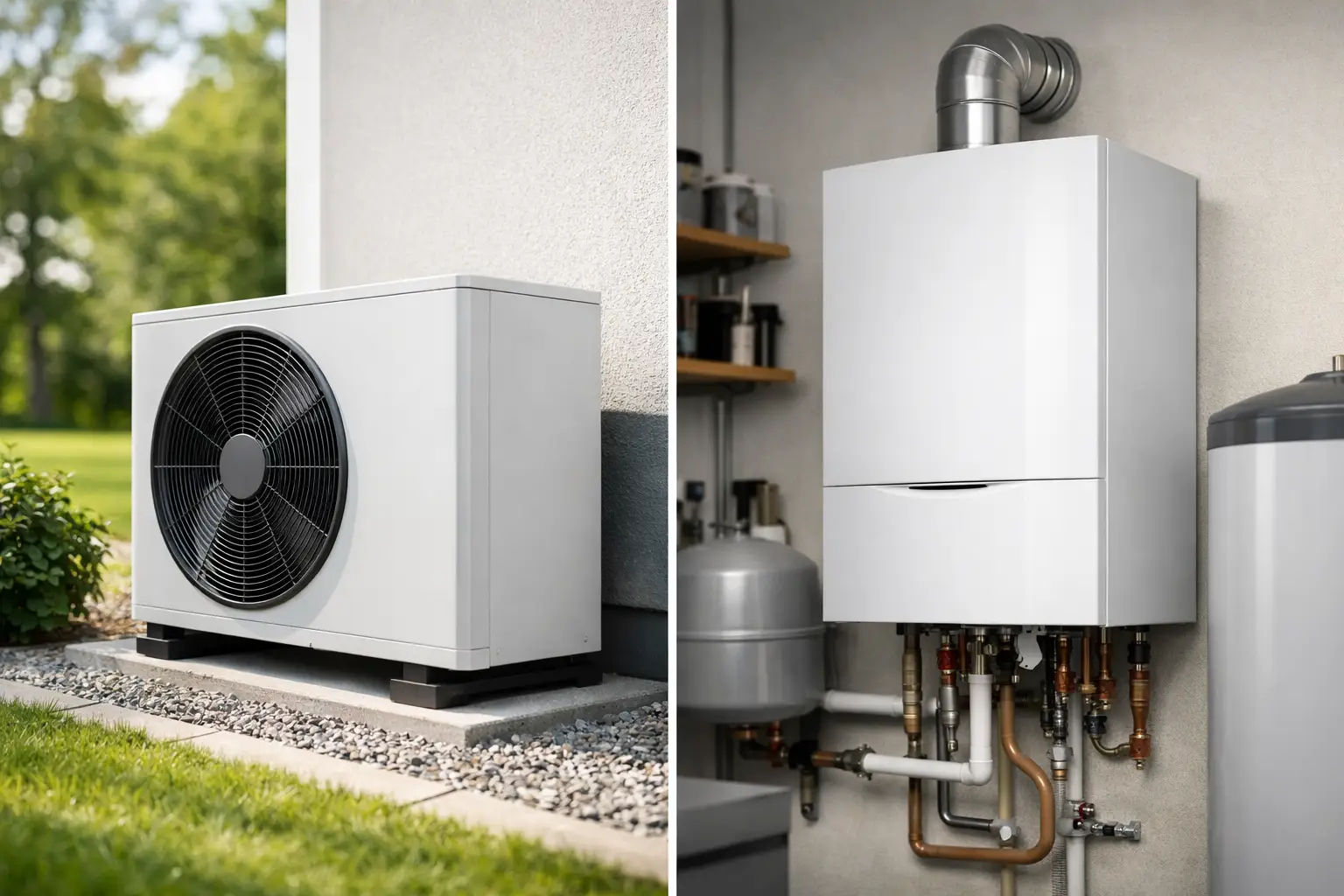
Your heating system matters most on the coldest day of the year, when the house needs to warm up quickly and the energy bill is already on your mind. That is why the heat pump vs gas boiler question is not really about trends. It is about what will keep your home comfortable at a sensible cost, both now and over the years ahead.
For some households, a gas boiler is still the more straightforward option. For others, a heat pump can cut running costs and bring a more future-friendly way to heat the home. The right answer depends on your property, your radiators, your insulation, your budget, and how long you plan to stay in the house.
Heat pump vs gas boiler: the basic difference
A gas boiler burns fuel to create heat. It heats water quickly and sends it through your radiators or underfloor heating, and it can usually provide hot water on demand if you have a combi boiler.
A heat pump works differently. Instead of creating heat by burning fuel, it moves warmth from the outside air into your home. Even when it feels cold outside, there is still heat energy in the air that the system can use. In most homes, that means an air source heat pump.
This difference matters because it affects everything else – running costs, how the home feels, how quickly rooms heat up, and what changes may be needed during installation.
Running costs are not as simple as they look
A lot of homeowners start with one question: which is cheaper to run? Fair enough. But there is no single answer that suits every home.
Gas has often been cheaper per unit than electricity, which gives boilers an advantage on paper. But heat pumps are much more efficient. A good heat pump can produce several units of heat for every unit of electricity it uses, while a boiler can never give you more heat than the fuel it burns.
That means a well-designed heat pump in a well-insulated property can compete very well on running costs, and in some homes it can come out ahead. If your home loses heat quickly, though, the picture changes. The system may need to work harder for longer, and the savings can be less impressive.
Energy prices also move around. What looks cheaper today may not stay that way forever. If you are comparing heat pump vs gas boiler purely on this winter’s tariff, you may miss the bigger picture.
Upfront cost is where the biggest gap usually appears
For most people, the real sticking point is the installation price.
A new gas boiler is usually cheaper to fit than a heat pump, especially if you already have a gas connection and a working wet heating system. Replacing an old boiler with a modern one can be fairly simple.
A heat pump normally costs more upfront. That is because the job can involve more than just changing the main unit. Some homes need larger radiators, pipework changes, hot water cylinder upgrades, or insulation improvements to get the best result.
That does not mean a heat pump is poor value. It means the full job needs looking at properly. Grants and funded routes can also change the maths for some households. If support is available, the jump from boiler cost to heat pump cost may be much smaller than expected.
Comfort feels different with each system
This is the bit many comparison articles miss. Boilers and heat pumps do not always heat a home in quite the same way.
A gas boiler tends to provide higher-temperature water to radiators. That means the radiators get hotter, and rooms can heat up quickly. If you are used to turning the heating on for a short burst and getting fast results, a boiler often fits that pattern well.
A heat pump usually works best at lower flow temperatures and over longer periods. Rather than blasting heat into the house, it keeps the temperature steady and consistent. Many people find that more comfortable once they get used to it. The house feels evenly warm rather than too hot one minute and chilly the next.
So the question is not only which system is stronger. It is also how you like to heat your home.
What this means for older homes
Older properties can still work with heat pumps, but they need honest assessment. If insulation is poor and draughts are a constant issue, replacing the heat source alone may not deliver the result you want.
In those homes, a gas boiler may seem like the easier answer because it can push out high heat quickly. But that can also mean you keep paying to heat a home that is losing warmth too fast. Sometimes the best route is improving the fabric of the property first, then looking at heating.
Installation disruption and practical changes
A boiler replacement is often the less disruptive option. If your home already has a gas boiler in place, the installer can usually swap it out with limited changes.
A heat pump install can be more involved. You need space outside for the unit, and inside you may need a hot water cylinder if you do not already have one. Radiators may need resizing, and the system design needs to be right from the start.
That sounds like a lot, and sometimes it is. But a good installer should make the process feel straightforward rather than overwhelming. The main thing is to know early on whether your home is a simple fit or a more complex one.
Hot water and daily use
Gas combi boilers are popular for a reason. They provide hot water on demand without needing a separate cylinder, which suits many households.
Heat pumps usually heat stored hot water in a cylinder. That works very well when the system is properly sized, but it is a different setup. For some homeowners, that is no problem at all. For others, especially where indoor space is tight, it may be less convenient.
This is one of those practical details that can shape the whole decision. The best heating system on paper may not feel best in daily life if it does not suit the way your household uses hot water.
Which is better for the future?
If you are thinking long term, heat pumps have a clear advantage in one area: they are more aligned with the wider move away from fossil fuels. As homes across the UK look for cleaner, lower-carbon heating, heat pumps are likely to become more common.
That does not make gas boilers a bad choice overnight. Plenty of homes still rely on them, and modern boilers can be efficient and reliable. But if you are planning major upgrades, staying in the property for years, or trying to reduce dependence on gas, a heat pump is worth serious consideration.
For homeowners looking for a simple path to lower bills and a more modern heating setup, this is where expert advice can save a lot of second guessing. Newtech Renewables helps households understand what is actually suitable for their home, rather than pushing a one-size-fits-all answer.
Heat pump vs gas boiler: when each one makes sense
A gas boiler often makes sense if you want lower upfront cost, your current setup already runs on gas, and you need a straightforward replacement with minimal disruption. It can also suit homes that still need major insulation improvements before a heat pump would perform well.
A heat pump often makes sense if your home is reasonably well insulated, you are happy with a steady style of heating, and you want to think beyond short-term replacement cost. It is also a strong option if you can access funding or if you are already improving the home’s overall energy efficiency.
The wrong choice is usually a rushed one
Problems tend to happen when homeowners choose based on a headline alone. A cheap boiler may not feel cheap after years of fuel costs. A heat pump sold as a miracle fix may disappoint if the property was never right for it in the first place.
The better approach is to look at the whole picture: the building, the heating habits, the available budget, and the likely savings over time.
So which should you choose?
If your priority is the lowest initial cost and a familiar system, a gas boiler may be the practical answer. If your priority is long-term efficiency, cleaner heating, and a more future-ready home, a heat pump may be the better fit.
Most households are not choosing between a good option and a bad one. They are choosing between two systems that solve the same problem in different ways. The key is making sure the system fits the home, not just the advert.
A good installer should leave you with fewer worries, not more. If the advice feels rushed, overcomplicated, or too good to be true, it probably is. The right decision usually starts with a clear look at your home as it is now, and what you want it to feel like next winter.