A roof does not need blazing sunshine all day to make solar worthwhile. If you are wondering can solar work on shaded roofs, the honest answer is yes, sometimes very well – but it depends on what is causing the shade, how much of the roof is affected, and whether the system is designed properly from the start.
This is where a lot of homeowners get mixed messages. One company says your roof is fine. Another says shade makes solar pointless. The truth sits in the middle. Some shaded roofs are poor candidates. Others can still cut energy bills nicely with the right panel layout, inverter setup and battery option.
Can solar work on shaded roofs in the UK?
Yes, solar can work on shaded roofs in the UK, including homes that do not get full sun from morning to evening. In fact, many British homes already generate useful solar power despite cloud cover, nearby trees or neighbouring buildings. Solar panels work on daylight, not just direct sunshine, so they still produce electricity in less-than-perfect conditions.
That said, shade does reduce output. A lightly shaded roof that only loses a bit of sun in the early morning is very different from a roof under heavy tree cover for most of the day. The question is not simply whether solar works. It is whether the savings will justify the cost for your home.
A proper assessment matters more than a quick guess. The best systems are designed around your roof as it actually is, not as if it were a perfect south-facing open space with no obstacles.
What kind of shade makes the biggest difference?
Not all shade behaves the same way. This is one of the main reasons solar quotes can vary so much.
Light, occasional shade
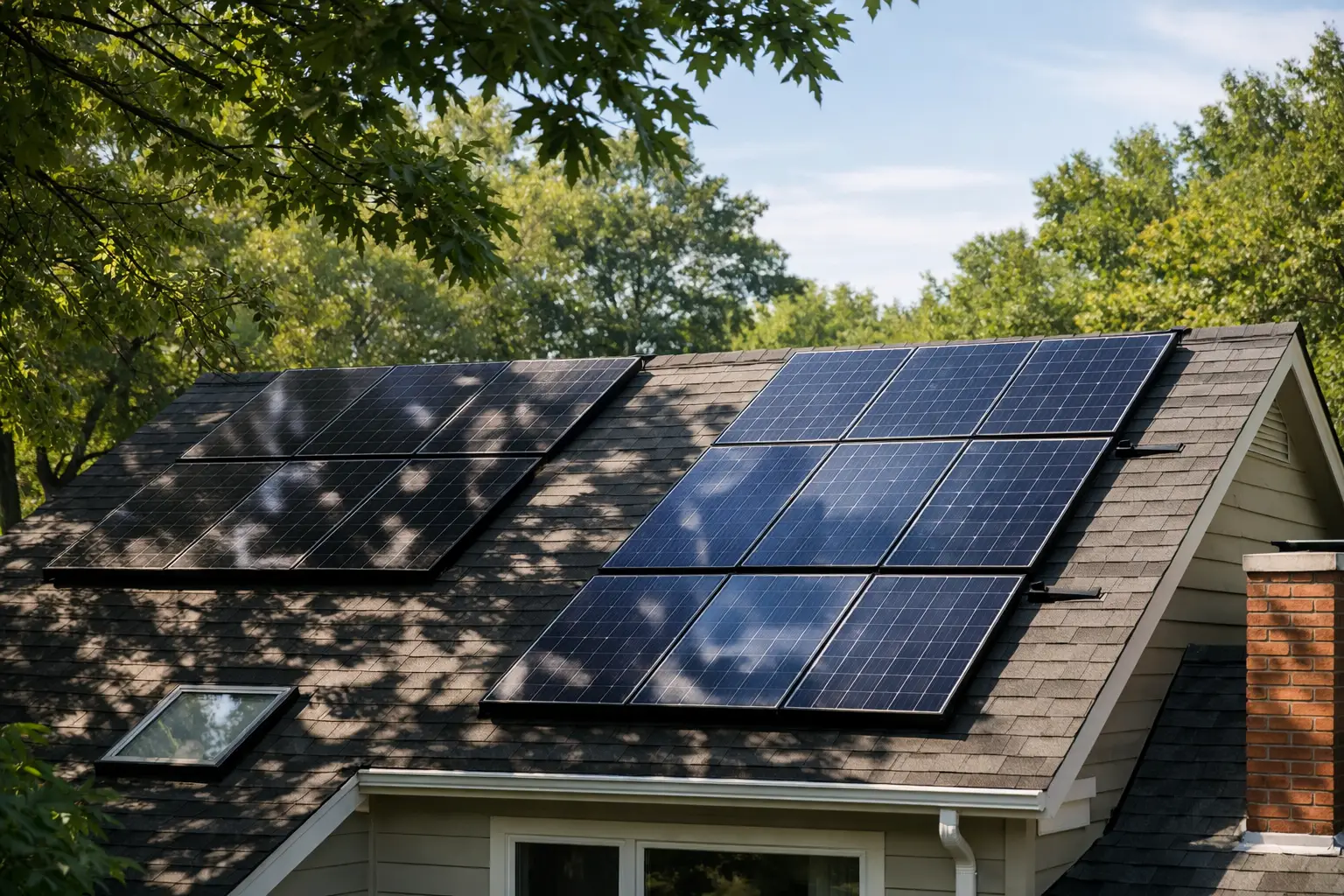
If shade only hits part of the roof at certain times – perhaps from a chimney, a dormer, or a nearby house in winter – solar may still perform well overall. These cases are often workable, especially if the unshaded roof space is still decent.
Seasonal shade
Trees are a common example. In winter, when the sun sits lower, branches can cast longer shadows. In summer, full leaf cover can block more light for longer parts of the day. Some homes lose only a small amount of generation. Others lose enough to make system design much more important.
Heavy, constant shade
If a roof spends a large chunk of the day shaded by tall buildings, dense trees or a poor roof position, the numbers may become less attractive. Solar may still generate power, but the payback period can stretch out. In some cases, a smaller system on the least shaded roof section is a better option than trying to cover the whole roof.
Why one shaded panel can affect the rest
Traditional solar systems can be sensitive to shade because panels are connected in strings. If one panel in that string is underperforming, it can drag down the output of others connected to it. That is why shade is not just about losing sunlight on one small patch of roof. It can affect the performance of a wider section of the system.
The good news is that modern system design gives you better ways to manage this. Panel-level optimisation and microinverters can reduce the impact of shade by letting panels work more independently. That means one shaded panel is less likely to hold back the rest.
This does not remove the effects of shade altogether, but it can make a noticeable difference on roofs with awkward angles, chimneys, skylights or passing shadows.
The best setup if your roof is partly shaded
If your roof is not fully open to the sun, the design of the system becomes far more important than the headline panel wattage.
Panel placement matters more than panel count
A smaller system placed on the clearest, brightest part of the roof can outperform a larger badly planned one. It is not always about fitting the maximum number of panels. It is about putting them where they can do the most useful work.
Optimisers or microinverters can help
These technologies are often worth considering for shaded roofs because they improve how each panel performs within the wider system. They can also help with monitoring, so you can see if one part of the array is being affected more than expected.
Battery storage can improve value
A battery does not solve shade, but it can improve the value of the electricity you do generate. If your roof produces a modest amount of power during the day, storing more of it for evening use can help you rely less on imported electricity when tariffs are higher.
For many households, especially those out during the day, this can make a real difference to savings.
When solar on a shaded roof still makes sense
Solar may still be a good investment if your roof gets decent midday sun, if only part of the roof is shaded, or if your household uses plenty of electricity during the day and evening. It can also make sense if you are pairing it with battery storage or planning to add other energy-saving upgrades over time.
Homes in Scotland and England often deal with less-than-perfect roof conditions. That is normal. A roof does not need to be textbook ideal to be worth looking at. What matters is whether the likely generation lines up with your usage and budget.
This is also where clear pricing and realistic expectations matter. A sensible installer should be open about what your roof can and cannot do. If the likely return is weak, you should be told that plainly.
When it may not be worth it
There are cases where solar on a shaded roof is hard to justify. If most of the usable roof area is in deep shade for much of the day, the system may generate too little to offer strong savings. If tree cover is growing thicker year by year, performance may worsen over time unless the trees can be managed.
There is also a cost balance to think about. Extra design features that help with shade can improve performance, but they may also increase the upfront price. On some roofs that trade-off is sensible. On others, it eats too far into the return.
This is why quick online calculators can be misleading. They often assume ideal conditions and do not reflect real obstructions, local roof angles or seasonal shading patterns.
How to tell if your shaded roof is suitable
The easiest way is to have the roof assessed properly. A good survey should look at the direction of the roof, pitch, usable space, nearby obstructions and how shade moves across the day.
It should also look beyond the roof itself. Your current electricity use, whether you are home in the daytime, and whether you want battery storage all affect whether solar will feel worthwhile financially.
If you want a simple rule of thumb, ask yourself three things. Is the shade constant or only occasional? Is there at least one roof area with reliable daylight for the middle part of the day? And are you looking for the best possible return, or simply a solid way to bring bills down over time? The answers usually give a better starting point than the old idea that any shade means no solar.
A realistic view of savings
On a shaded roof, savings are usually lower than on an unshaded one. That sounds obvious, but it is better to say it clearly than pretend every home will get the same result. What matters is whether the system still delivers enough value for the price you pay.
For some households, even a reduced-output system can be worthwhile because it trims daytime electricity costs, works well with a battery and protects against rising energy prices. For others, the better route may be to improve insulation first, replace an old boiler, or look at a different mix of upgrades before installing solar.
That is the practical way to look at it. Solar is not all-or-nothing. It is one part of a bigger plan to make your home cheaper to run.
Newtech Renewables takes that same common-sense approach. If a roof is suitable, the focus should be on a system that is simple, fairly priced and designed around real savings, not sales talk.
If your roof gets some shade, do not rule solar out too quickly – but do not accept a one-size-fits-all promise either. A straightforward assessment can tell you whether it is a smart move for your home, your budget and the way you actually use energy.