A solar battery can make the electricity your panels produce work harder for your household. Rather than sending spare daytime power straight to the grid, you store it to use when the kettle is on, the children are home, or energy prices are higher. This guide to solar battery installation explains what is involved, what to expect from the process, and how to avoid paying for more storage than you need.
For most homes, battery storage is not about becoming fully off-grid. It is about buying less electricity from your supplier, using more of your own solar power and having better control over when you use energy. The right system should feel simple once it is fitted – not like another complicated piece of technology to manage.
Is a solar battery right for your home?
A battery is often a sensible addition if your solar panels generate plenty of power while the house is empty during the day. Without storage, much of that unused electricity is exported. With a battery, it can be held back for the evening, when household demand is usually higher.
It can also suit homes on time-of-use tariffs, where electricity costs less overnight and more at peak times. Some batteries can charge from the grid at cheaper times, then supply your home when rates rise. Whether this saves money depends on your tariff, the battery settings and how much electricity you use.
Battery storage is not automatically the best choice for every property. If you are home most days and regularly use appliances while the sun is out, you may already use a high proportion of your solar generation. Equally, if your energy use is very low, a large battery could take a long time to justify its cost. A proper assessment looks at your roof, existing solar system, electricity use and budget together.
Choosing the right battery size
Battery capacity is measured in kilowatt-hours, or kWh. In simple terms, this tells you how much electricity it can store. A typical family home may consider a battery in the region of 5kWh to 10kWh, but there is no single correct size.
A smaller battery can be a good fit where the aim is to capture a little daytime solar for evening use. A larger battery may make sense for bigger households, homes with high electricity demand, electric vehicles, heat pumps, or solar arrays that generate a lot of surplus power. More capacity is not always better, though. If a battery rarely fills, the extra storage is unlikely to deliver the value you expected.
It is also worth looking at usable capacity rather than just the headline number. Batteries protect their cells by keeping a small amount of energy in reserve, so a 10kWh unit may not offer the full 10kWh for everyday use. Your installer should explain this clearly, alongside the warranty, expected lifespan and how much power the battery can deliver at one time.
Power matters as well as capacity
Capacity is the size of the energy store. Power output is how quickly the battery can supply electricity. A battery may have enough stored energy for an evening, but a lower output could limit how many high-demand appliances it can support at once.
This matters if you regularly run an oven, shower, tumble dryer or electric heating at the same time. It does not mean every home needs the highest-output model. It simply means the battery should be matched to the way your household actually uses electricity.
What happens during solar battery installation?
A stress-free installation starts before anyone arrives with tools. Your installer should first check whether your property and current electrical setup are suitable. For a new solar and battery system, this is usually covered during the home survey. If you already have panels, the installer will check the inverter, generation figures, consumer unit and available space before recommending the best route.
Some batteries work with a hybrid inverter, which manages both the panels and the battery. Others can be added to an existing solar system using an AC-coupled arrangement. Neither approach is automatically better. The most practical choice depends on the equipment you already have, the age of your system and what you want the battery to do.
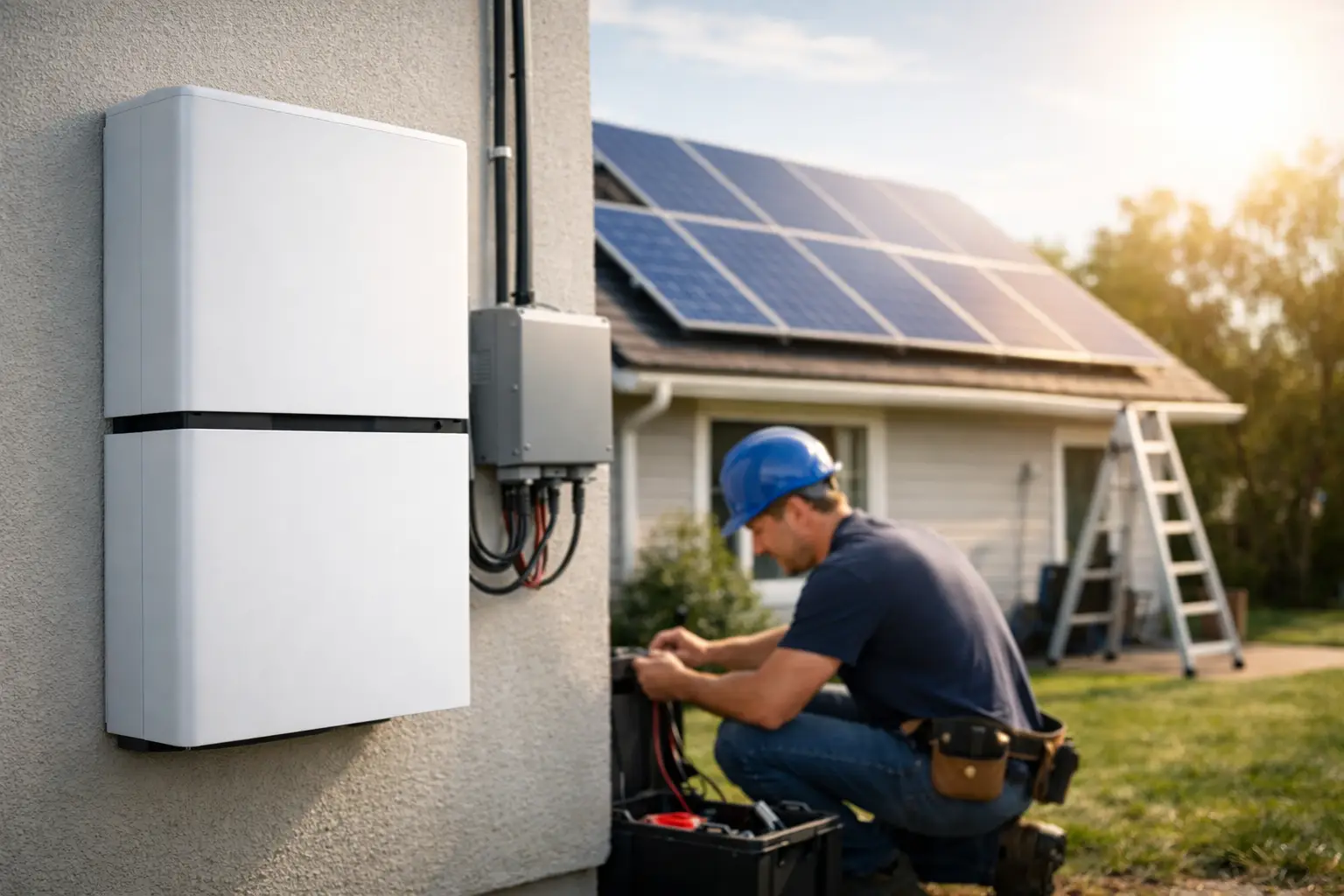
On installation day, the team will normally mount the battery in an appropriate location, connect it safely to the electrical system and configure the controls. Many domestic batteries are fitted in a garage, utility room or another suitable area with adequate space and ventilation. The exact location needs to meet the manufacturer’s instructions and current electrical and fire-safety requirements. A battery should not be placed somewhere solely because it is out of sight.
The work often takes a day for a straightforward installation, although upgrades to the consumer unit or more complex systems can add time. Your installer should leave the area tidy, show you how the system works and provide the paperwork you need.
Permissions, notifications and paperwork
Most domestic solar battery installations do not require planning permission, particularly when the battery is installed inside the home or in a suitable external location. There can be exceptions, including listed buildings, conservation areas and unusual external installations, so it is wise to check before work begins.
Your installer also needs to deal with the local electricity network operator. In the UK, systems that connect generation or storage equipment to the grid must follow the relevant connection process, often referred to as G98 or G99. This is not something you should have to chase yourself. It is part of getting the installation completed properly and safely.
Keep your handover documents in a safe place. These should include product warranties, electrical certification, system details and instructions for the monitoring app. If you receive payments for exporting electricity, make sure your supplier has the correct meter information after the system is commissioned.
Can a solar battery keep the lights on in a power cut?
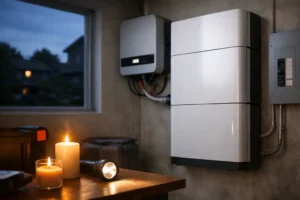
Not necessarily. This catches many homeowners out. A standard battery installation usually switches off during a power cut to protect network engineers working on local lines. Having stored electricity does not automatically mean your sockets will stay live.
If backup power is important, ask about it at the design stage. Some systems can provide an emergency power supply or back up selected circuits, such as lighting, broadband, a fridge and a few sockets. Whole-home backup may be possible in some properties, but it needs careful design and can increase the cost. It is a useful feature for some households, not a requirement for everyone.
How much does installation cost?
The price of a solar battery installation varies with capacity, brand, inverter requirements, electrical work and whether you are adding storage to existing panels or installing everything together. A clear quote should show what is included, rather than presenting one low figure that grows once work starts.
Ask whether the price covers the battery, inverter where required, fitting, electrical certificates, network notification, monitoring setup and VAT. Also ask what could create an extra charge, such as consumer-unit upgrades, difficult cable routes or groundwork for an external unit. Clear answers early on are the best way to avoid surprises.
The cheapest battery is not always the most affordable over its lifetime. Consider the length and terms of the warranty, the usable capacity, installer support and whether the system can be expanded later. Good value means a system that fits your home and is installed properly, not simply the lowest upfront price.
Getting the best savings after fitting
Once your battery is running, use the monitoring app for the first few weeks. You do not need to watch it constantly, but it can reveal useful patterns: how much solar you generate, when the battery fills, and when you still buy electricity from the grid.
Small changes can improve the benefit. Running the washing machine or dishwasher during sunny hours can leave more stored energy for the evening. If you have a smart tariff, make sure the charging schedule matches the rates you are actually paying. Seasonal changes matter too. A battery may charge more from solar in summer and rely more on cheaper overnight grid electricity in winter.
A well-planned battery should reduce hassle, not add to it. Newtech Renewables helps homeowners look at the full picture – from solar generation and household demand to straightforward installation and honest costs. The most useful next step is a home assessment that turns your energy habits into a system size and price you can trust.