
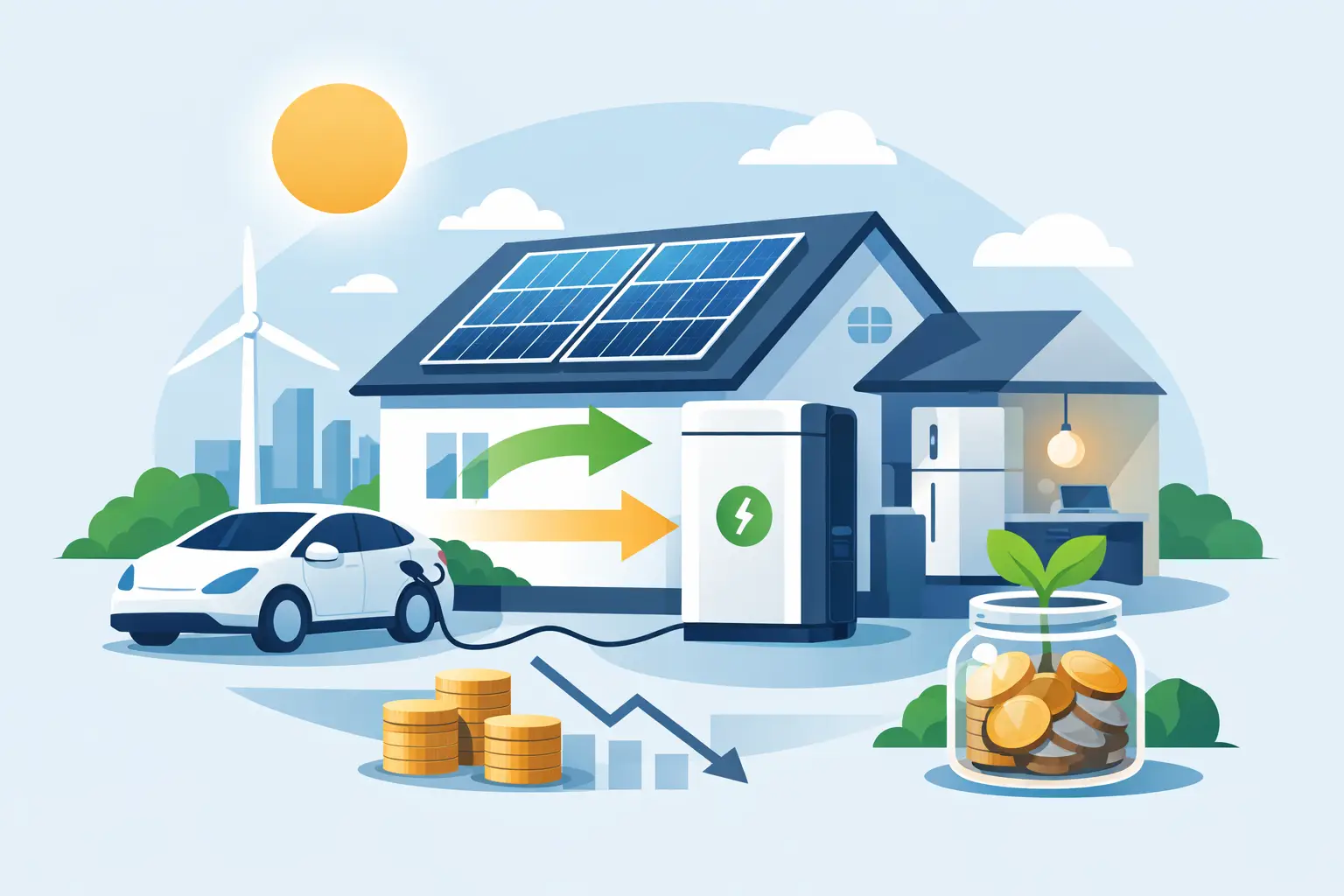
If your electricity bill seems to jump every time prices change, battery storage can give you some control back. The simplest way to understand how battery storage saves money is this: it lets you use more of the cheaper electricity you already have and buy less of the expensive electricity you do not want to rely on.
For most homeowners, that matters more than the technical detail. You are not buying a gadget for the sake of it. You are buying a way to shift when you use electricity, especially if you already have solar panels or you are considering them.
How battery storage saves money in real life
A home battery stores electricity for later use. That electricity might come from your solar panels during the day, or from the grid at a cheaper time if you are on a time-of-use tariff. Later, when your home needs power in the evening or early morning, the battery can supply some of it instead of you importing electricity at a higher rate.
That simple switch is where the savings come from. Without a battery, a lot of daytime solar generation can go unused in the home because many people are out at work, school or running errands. The panels may still generate well, but if nobody is using much power at that moment, the benefit is limited. With battery storage, that spare energy is kept for later.
Picture a typical household. The washing machine is not always running at midday, but the oven, lights, television and devices often come on in the evening. A battery helps move your solar benefit from the middle of the day to the time when your household actually needs it.
The main ways homeowners reduce their bills
The first saving usually comes from using more of your own solar electricity. This is often called increasing self-consumption, but in plain English it just means wasting less of what your system produces. The more of your own power you use at home, the less you buy from your supplier.
The second saving can come from avoiding peak electricity prices. Some tariffs charge more at busy times and less overnight or during off-peak periods. A battery can be charged when electricity is cheaper and then used later when rates rise. That can make a noticeable difference, especially in homes with steady evening use.
The third saving is longer-term protection against rising prices. No system stops energy costs completely, and savings vary from home to home, but battery storage can reduce your exposure to future price spikes because you are less dependent on buying electricity at the worst times.
Battery storage and solar work best together
Battery storage can work without solar, but the strongest case for most homeowners is a battery paired with solar panels. Solar on its own can still lower bills, but a battery helps you hold on to more of that value.
Without a battery, your panels may generate well at noon while your home only uses a small amount. With a battery, that extra power is stored and used later. That means fewer units imported from the grid in the evening, which is often when families use the most electricity.
This is one reason battery storage often appeals to people who already have solar and feel they could be getting more from it. It can also make sense for new installations where the goal is simple: lower bills and better use of the energy your roof can generate.
How battery storage saves money without solar
Even if you do not have solar panels, battery storage can still reduce costs in the right setup. This usually depends on your electricity tariff.
If your tariff offers cheaper electricity overnight, the battery can charge during those low-cost hours and discharge during the day or evening. In effect, you are buying electricity when it is cheaper and using it when it would otherwise cost more.
That said, the savings are often more limited without solar, and the numbers depend heavily on tariff structure and usage habits. If you are at home all day and use a lot of electricity evenly across the day, the benefit may be different from a household that uses most of its power between 5pm and 10pm. This is where honest advice matters, because battery storage is not a one-size-fits-all answer.
What affects the amount you save
Two homes can install similar batteries and see different results. That is normal. Savings depend on how much electricity you use, when you use it, whether you already have solar, and what tariff you are on.
Households with high evening usage often see clearer value because they can replace more expensive grid electricity at the time they need it most. Families who are out all day and use most of their electricity after work can also benefit because stored daytime solar becomes much more useful.
Battery size matters too. A larger battery is not automatically better if your home does not need that much stored energy. Oversizing can stretch the upfront cost without delivering enough extra savings to justify it. On the other hand, a battery that is too small may fill and empty too quickly to make the biggest difference.
Your existing system also plays a part. If your solar array is modest and your daytime generation is limited, a very large battery may not have enough spare electricity to charge properly. The best results tend to come from systems designed around real household use rather than guesswork.
The trade-off: upfront cost versus long-term savings
Battery storage can save money, but it does involve an upfront investment. That is why the right question is not just, “Will this cut my bills?” but also, “Will it do so enough to make sense for my home and budget?”
For some households, the answer is clearly yes, especially if they already have solar or are installing it at the same time. For others, the payback period may be longer, and that can still be acceptable if the priority is better energy control, less waste and lower reliance on the grid.
It also depends on expectations. Battery storage is not usually about wiping out your electricity bill entirely. It is about reducing it in a practical, steady way while making the most of your system.
Why simple system design matters
A good battery setup should feel straightforward, not complicated. The system should be sized around how your home actually works, not around technical features you may never use.
That means looking at your electricity habits, your roof’s solar potential if relevant, and whether your tariff supports the savings you want to achieve. It also means understanding if your current setup is suitable for an upgrade or whether a more joined-up approach would work better.
This is where many homeowners get stuck. They know they want lower bills, but they are presented with too much jargon and too many options. In reality, the best solution is usually the one that fits your property, your usage and your budget without adding stress.
Is battery storage worth it for every home?
Not every home will see the same return, and it is better to be clear about that. If your electricity use is already very low, or if most of your usage happens during the day when solar is already covering it, the extra savings from a battery may be smaller.
But for many households, especially those dealing with high evening energy use, battery storage can be a sensible step. It gives you more control over when you use power, helps you get more from solar, and reduces the amount of electricity bought at higher rates.
For homeowners in England and Scotland who want lower bills without a complicated process, that practical benefit is often the real selling point. It is not about turning your home into a science project. It is about using energy more wisely and keeping more of your money in your pocket.
If you are weighing up your options, the most useful starting point is to look at your current bills and your daily routine. When does your home use the most electricity? How much of that could be shifted or covered by stored power? Once those answers are clear, battery storage becomes much easier to judge.
A well-chosen battery will not just sit quietly on the wall. It will work in the background, helping your home use cheaper, smarter energy day after day.