If your boiler is struggling, your rooms never quite warm up, or your energy bills keep climbing, a guide to funded boiler upgrades can save you a lot of wasted time. Many homeowners know support is out there, but the hard part is working out what is real, what you might qualify for, and what happens after you apply.
The good news is that funded upgrades are designed to make heating improvements more affordable. The less good news is that eligibility, property type, and existing heating setup all matter. That means there is no single answer for every home, but there is a clear way to approach it without the stress.
What funded boiler upgrades actually mean
Funded boiler upgrades usually refer to schemes that help eligible households replace old, inefficient or unsuitable heating systems at a lower cost, or sometimes with no upfront cost at all. In many cases, funding is linked to wider home energy efficiency improvements rather than simply swapping one boiler for another.
That point matters. If you are picturing a quick boiler replacement with no checks, that is not always how it works. The property may need an assessment first, and the recommended upgrade could depend on insulation levels, your current fuel type, your EPC rating, and whether another heating solution would suit the home better.
For some households, a funded upgrade will mean a modern, energy-efficient boiler. For others, it could involve a different heating improvement as part of a broader package. The aim is usually the same – lower running costs, better comfort, and a home that wastes less heat.
Who may qualify for a funded boiler upgrade
This part is where most people get stuck, because the rules can seem vague. In practice, qualification often depends on a mix of household circumstances and property details.
Support is commonly aimed at households on certain benefits, people living in homes with poor energy efficiency, or properties with older heating systems that are expensive to run. Some schemes also consider income, health vulnerabilities, or whether the home is difficult to heat.
That does not mean you should rule yourself out if you are unsure. Plenty of homeowners assume they will not qualify and never check properly. Just as often, people expect a funded boiler replacement only to find the scheme offers a different upgrade that is better suited to the property.
The simplest way to think about it is this: if your home is expensive to heat and your current system is old, unreliable, or inefficient, it is worth checking.
Why eligibility is not always straightforward
Two homes on the same street can get different outcomes. One might qualify because of the occupier’s circumstances and the property’s energy rating. The other might not, even if the boiler is the same age.
That can feel frustrating, but it is normal. Funding schemes are built around set criteria, and those criteria can change. A proper assessment helps cut through guesswork and shows what is genuinely available for your home rather than what sounds good in an advert.
A practical guide to funded boiler upgrades
The easiest way to avoid confusion is to treat the process as a step-by-step check rather than a sales pitch. A good provider should make things clear from the start.
First, check whether your current heating system is actually eligible. An old boiler on its own is not always enough. The type of property, current energy performance, and your household situation may all come into play.
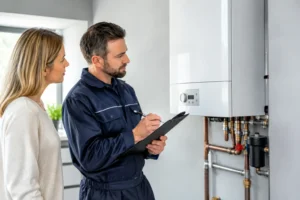
Next, expect some form of home or suitability assessment. This is not there to complicate things. It helps confirm what improvement makes the most sense and whether the property meets the scheme rules.
After that, documentation is usually needed. Depending on the route, this might include proof of address, benefit details, or information about the existing heating system. If a provider cannot explain what they need and why they need it, that is a warning sign.
Once approved, the installation process should be explained in plain English. You should know what is being fitted, whether any extra works are needed, how long it should take, and whether there are any costs not covered by funding.
The best experiences are the ones that feel managed from start to finish. That is especially important if you have already spent weeks chasing different companies for answers.
What is usually covered – and what might not be
This is where clear expectations really help. Some funded routes cover the full cost of the upgrade, while others only cover part of it. Some include related measures if they are needed to make the heating system work properly. Others are more limited.
A boiler upgrade may involve more than the boiler itself. There could be controls, pipework changes, or other adjustments to bring the system up to standard. Sometimes those items are included. Sometimes they are not.
This is why “funded” does not always mean “everything is free”. It can, but not in every case. A trustworthy installer will tell you early on if there is any customer contribution, what it covers, and whether there are alternatives.
If that conversation feels vague, push for detail. Hidden surprises are the last thing you need when you are trying to cut household costs.
When a boiler upgrade is the right option
For many homes, replacing an old boiler with a modern efficient model is still a sensible move. If your property already uses a wet central heating system and a boiler remains the best fit, an upgrade can improve reliability and help reduce fuel use.
You may notice quicker heating, better hot water performance, and lower bills compared with an older, less efficient unit. If your existing boiler breaks down regularly or struggles to heat the house properly, replacing it can make daily life much easier.
That said, the right option depends on the property. Some homes may benefit more from another heating solution, especially if the funding route is focused on long-term efficiency improvements rather than like-for-like replacements.
When another heating upgrade may be suggested
Not every funded pathway centres on gas boilers. Depending on the property and the scheme, alternatives such as an air source heat pump or wider energy efficiency works may be recommended.
That can sound like a complication, but it is not always a bad thing. If the home is suitable, a different system could offer better long-term savings and performance. The key is getting advice that is based on your home, not a one-size-fits-all script.
A sensible provider will explain the trade-offs. A boiler upgrade may be simpler in some properties. A different system may bring better future savings in others. Good advice is about fit, not pressure.
Common mistakes to avoid
One of the biggest mistakes is applying based on headline promises without checking the detail. If you have seen adverts claiming everyone qualifies, be cautious. Funding is usually more specific than that.
Another mistake is focusing only on the boiler and ignoring the condition of the home. If insulation is poor or heat is escaping through the building fabric, changing the boiler alone may not deliver the results you hope for.
It is also worth being careful with companies that rush the process or avoid giving straight answers about paperwork, timescales, or possible extra costs. A funded upgrade should still feel professional, clear, and properly assessed.
Finally, do not wait for a full breakdown in the middle of winter if your current system is already failing. The earlier you check your options, the easier it is to plan without the pressure of having no heating or hot water.
How to choose the right installer
A funded scheme is only as good as the company handling it. You want an installer who explains things simply, checks the property properly, and tells you what is realistic from the start.
Look for clear communication, straightforward timelines, and honest answers about whether you qualify. If the process feels confusing before any work has started, it rarely gets better later.
This is where working with a practical, consumer-friendly company makes a real difference. Newtech Renewables, for example, focuses on making home energy upgrades simpler and less stressful, which is exactly what most households need when they are weighing up funding options.
Is a funded upgrade worth it?
For the right household, yes. A funded boiler upgrade can cut upfront costs, improve comfort, and reduce the financial strain of keeping your home warm. It can also take the pressure off replacing an ageing system entirely out of your own pocket.
But it is worth it only if the upgrade matches your home and the terms are clear. The goal is not just to get funding. It is to end up with a heating system that works well, costs less to run, and gives you fewer worries when the weather turns colder.
If you are unsure where to start, keep it simple. Ask what you may qualify for, what your home actually needs, and what the full process looks like before you agree to anything. A warmer home should feel easier to achieve than most people think.